
Data Embassy: relocating sovereign data vaults
Rédigé par Régis Chatellier
-
19 November 2026Initially designed to store and preserve a State’s data outside its geographical borders, the concept of data embassy is now evolving towards the provision of offshore computing infrastructure for AI, subject to the laws and regulations of the client State or relevant stakeholders.
Protecting territory from afar
In 2007, Estonia was targeted by a cyberattack attributed to Russia, involving Distributed Denial of Service (DDoS) attacks that paralysed public services and the banking system. The main web servers of banks, government agencies and the President’s Office were affected. Hackers also threatened to leak private messages exchanged by members of parliament, along with their bank account details. One of the largest attacks of its kind at the time, it lasted from 27 April to 18 May 2007. It significantly disrupted the banking sector and threatened to bring down the entire public sector communications network.
Ten years later, on 20 June 2017, the Republic of Estonia and the Grand Duchy of Luxembourg signed an Agreement on the Hosting of Data and Information Systems, aimed at hosting Estonian data in Luxembourg. The agreement was subsequently incorporated into Luxembourg law on 1 December of the same year. This arrangement later became known as a “Data Embassy”. According to the French-language Wikipedia page on data embassies, they are defined as a “solution traditionally implemented by nation-states to ensure a country's digital continuity, particularly with regard to critical databases. It consists of a set of servers that store a country's data and fall under that country's jurisdiction while being physically located in another country.” In Estonia's case, as reported by a Politico article, the objective is to safeguard “security databases, population registers and land ownership records [...] against cyberattacks, sabotage and even a Russian invasion”.
From magnetic tapes to secure data centres
Estonia had already been storing sensitive data outside its borders in analogue form. In an interview with Politico, Alan Allmere, who led Estonia's data embassy project, explains that the government used to put information “onto magnetic tapes, which staff would then place in suitcases, board a plane, travel to an Estonian embassy somewhere around the world and store them in the safe.” Embassies do indeed enjoy diplomatic immunity.
The inviolability of diplomatic missions is guaranteed under Article 22 of the 1961 Vienna Convention : “The receiving State is under a special duty to take all appropriate steps to protect the premises of the mission against any intrusion or damage”; “The agents of the receiving State may not enter them, except with the consent of the head of the mission”; and “The premises of the mission, their furnishings and other property thereon [...] shall be immune from search, requisition, attachment or execution".
An embassy in the form of a technical architecture
Estonia’s data embassy is not physically located within its diplomatic embassy, but rather in a data centre owned by the Luxembourg Government. Estonia chose the Grand Duchy because of the quality of its infrastructure, as explained in a 2018 article by Estonian World: “Luxembourg was chosen as the hosting partner because it has highly secure, fault-tolerant Tier 4-certified government data centres, capable of withstanding any unforeseen event while maintaining operations. There are currently no equivalent data centres in Estonia.” Building dedicated infrastructure of this standard within the embassy premises would either be impossible or prohibitively expensive. This is precisely what has driven the development of such hybrid solutions: extending the legal framework and protections associated with diplomatic missions to data centres, rather than building a dedicated data centre within the embassy itself.
It adopts the characteristics of a traditional embassy through a bilateral agreement signed in 2017. Article 3, in particular, guarantees that “The premises shall be inviolable and shall therefore not be subject to any search, requisition, seizure or enforcement measure” and that “No official or person exercising public authority, whether administrative, judicial, military or police, of Luxembourg may enter the premises without the prior authorisation of the authorised representative of the Republic of Estonia.” Article 4 further stipulates that “The Grand Duchy of Luxembourg shall take all appropriate measures to protect the premises against any intrusion or damage on Luxembourg territory”, thereby ensuring “the same level of protection as that enjoyed by the Grand Duchy of Luxembourg”. The equipment and software (including licences) also benefit from immunity under Article 5. They are “considered to be property of the Republic of Estonia and shall enjoy immunity from any form of judicial proceedings”.
In practice, this data embassy, which became operational in 2019, enables encrypted data to be transferred from Estonia to Luxembourg via private internet connections. This data can only be accessed, either remotely or physically, by authorised Estonian officials. Politico explains that the initial version comprised ten sets of essential data, including information about citizens, their land ownership records and the country's legislation “everything a government would need to restart after a disaster”. It now also hosts the country's operational government services, including “part of the government's cloud infrastructure”.
From data backup facilities to AI computing infrastructure
Following Estonia's initiative, several principalities and states have positioned themselves to establish their own data embassies or become hosting providers. In 2021, Monaco signed an agreement with Luxembourg to establish its data embassy there.
As early as February 2023, the NGO Datasphere announced that the Indian government was working on a new policy to allow data embassies to be hosted on its territory, “in certain special economic zones” that would benefit from “diplomatic immunity” from local laws and create “trust bubbles” at the heart of complex geopolitical equations. By 2025, Singapore was considering the possibility of establishing a “data embassy” in GIFT City, a new financial hub under development in the state of Gujarat. India is also exploring the establishment of reciprocal agreements with the United Arab Emirates, “under which each state could host secure repositories of strategic information for the other and serve as a mutual refuge for their critical data”. However, as of 2026, India still has no specific legal framework governing the establishment and operation of such “data embassies”. Politico also refers to legislation in Bahrain that allows “institutions to store data on the Emirate's servers while keeping it subject to the laws of their country of origin”. Saudi Arabia, for its part, is reportedly considering positioning itself as a “global hub for AI digital embassies”.
These embassies are now also being considered as a means of providing or pooling offshore artificial intelligence infrastructure for states that lack such capabilities, or have insufficient capacity, within their own national borders.
In a white paper published in May 2026, AI Infrastructure in the Age of Sovereignty: Requirements, Strategies and a Trusted Framework for Digital Embassies, the World Economic Forum (WEF) describes digital embassies as “a viable sovereign infrastructure option within the broader landscape of national AI infrastructure strategies”. They “expand the traditional notion of digital sovereignty – once tied to national borders and physical territories – by demonstrating how trusted sharing agreements can preserve control and governance over data and digital operations, even when hosted abroad”. The aim, therefore, is to complement rather than replace other sovereign AI infrastructure options, such as national clouds, trusted compute-sharing agreements and federated data infrastructures. However, deploying such solutions remains complex. According to the WEF, stakeholders must assess not only the costs involved, but also geopolitical risks (such as armed conflicts and sanctions), as well as other crisis scenarios (including cyberattacks and natural disasters) as part of their overall assessments.
In collaboration with a community of stakeholders, the Forum has developed a global framework for innovative and trusted digital embassies, with the aim of strengthening trust between economies and fostering resilient digital embassy agreements. According to the World Economic Forum, when effectively managed, digital embassies can provide a credible option for extending sovereign AI infrastructure beyond national borders.
The concept of digital embassies is also being promoted in Africa by one of the continent's largest telecommunications operators, MTN Group. The initiative would involve developing sovereign AI infrastructure solutions not merely at the national level, but across the continent, through the creation of regional hubs where countries and companies from neighbouring states could install servers that remain subject to the laws of their country of origin. According to the company, the aim is to pool computing capacity while enabling countries to retain sovereignty over their data.
Initiatives to be considered in the broader debate on digital sovereignty
Although the concept of digital embassies first emerged in Estonia nearly twenty years ago, their revival and growing development in the international context are part of broader debates surrounding the notion of digital sovereignty, whose definition has yet to be firmly established at European level. To date, the definition of digital sovereignty, according to an Atlantic Council article, depends on whom you ask. Sovereignty can be understood from several perspectives: territorial sovereignty: the location and processing of data on European soil; legal sovereignty: the ability to protect against extraterritorial access to data, particularly through the US CLOUD Act; competitive sovereignty: the development and protection of European companies and developers of digital solutions.
The draft European Tech Sovereignty Package, presented by the European Commission in June 2026, includes the Chips Act 2.0, the Cloud and AI Development Act, an Open Source Strategy, and a Strategic Roadmap for Digitalisation and AI in the Energy Sector. It proposes a definition of digital sovereignty, which had previously been absent from EU legislation. This definition places particular emphasis on dependencies: “Technological sovereignty refers to Europe's ability to develop, control and deploy at scale the essential technologies, infrastructures, services and data, including digital ecosystems, that underpin its economy, security and society, while reducing risks and diversifying supply chains and technological exposure in order to reduce strategic dependencies and withstand foreign interference”.
Differences in approaches to digital sovereignty became particularly apparent at the European Council in October 2025. France advocated a more centralised approach aimed at achieving autonomy in key technologies, while Germany favoured a more open approach, including collaboration with US companies. On 17 June 2026, however, France and Germany reached an agreement on digital sovereignty and adopted a common definition in a joint paper: “the ability to develop, provide, use, adapt and control digital technologies, including hardware, independently, autonomously and securely, in order to strengthen the capacity of the EU, a State, a public administration or a private entity to act independently and retain ultimate decision-making authority over processes and activities”.
In this context, data embassies offer a distinctive model: extraterritorial bubbles protected from external interference by a governance framework that ensures the application of the domestic law of the State choosing to use them. Sovereignty is no longer based solely on territoriality, nor on control or ownership of the physical and software infrastructure, but rather on the agreements governing the establishment and operation of these embassies. In international relations, they fit within the framework of Shelter Theory (Wivel & Ingebritsen, 2019), according to which small states seek protection from more powerful neighbours and international organisations in order to meet their needs and mitigate the vulnerabilities inherent in their small size, as was the case with Estonia. A similar model can be found in the African example, where the approach would rely on pooling resources and infrastructure. Data embassies require clear agreements, a framework of trust between stakeholders, and guarantees that these agreements will be upheld by all parties.
As the WEF points out, “unclear rules governing data classification, residency, access or cross-border flows can create uncertainty and erode trust. Establishing transparent and comprehensive data governance principles is essential.” These data embassies therefore represent an example of a political and contractual agreement governing digital infrastructure, offering an original form of digital sovereignty within a space of interdependence between state actors.
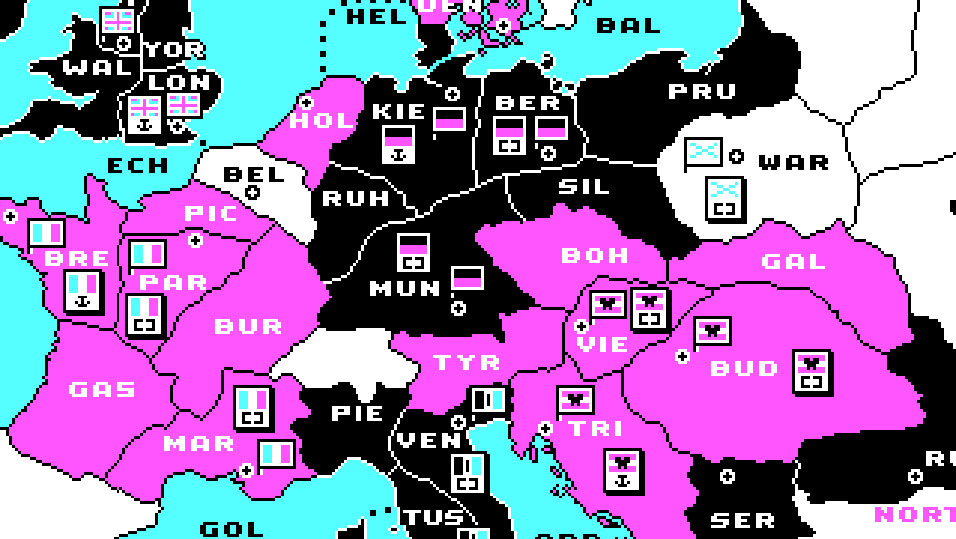
Illustration: Screenshot from the video game Diplomacy (Avalon Hill), released for the IBM PC in 1984.