
Agentic AI: what are we talking about?
Rédigé par Romain Darous
-
02 September 2026The emergence of agentic AI first raises the question of what this term actually means. Although the concept itself is not new, it has taken on a new significance in the era of generative AI. To date, there is no universally accepted definition of agentic AI or AI agents. This is illustrated by the OECD’s February 2026 report, which identifies around ten different proposed definitions - each reflecting a distinct perspective. The terminology remains ambiguous, with varying scopes and overlapping concepts. Between marketing-driven labels, confusion with established terms such as conversational agent, and inconsistent definitions, it is far from straightforward to clearly define agentic AI and the systems it encompasses. In this article, we therefore provide an overview of both historical and contemporary terminology to help clarify the emerging—or perhaps not so new - landscape of agentic AI.

The Prehistory of Agentic AI
As explained in a research article by Sapkota et al. (2025), the term AI agent (from the Medieval Latin agens, the present participle of agere, meaning "to act" according to the Académie française Dictionary) predates the emergence of generative AI models in 2022. Originally, it referred to "entities endowed with autonomy, perception, and communication capabilities, with a particular emphasis on their applications in distributed problem solving, collaborative robotics, and synthetic world simulations." AI agents were initially designed as expert systems capable of performing specific tasks with a degree of autonomy and a limited ability to adapt to dynamic environments. Examples include intelligent robotic vacuum cleaners that make simple decisions based on sensor data (such as avoiding obstacles or systematically covering an entire room), as well as non-player characters (NPCs) in video games whose actions are driven by decision trees. In its report on agentic AI, the CIANum also highlights “Shakey”, a robot developed in the 1960s and widely regarded as the first autonomous robot.
The interaction of multiple agents gives rise to more complex systems known as multi-agent systems, a term that can be regarded as the predecessor of what is now called agentic AI. Each agent is endowed with its own characteristics and capabilities and operates within a defined environment, whether virtual or physical. Agents interact both with one another and with their environment in a decentralized manner, without central coordination or explicit instructions. For example, an urban traffic simulation may model the interactions between individual vehicles (the agents), each governed by rules relating to speed, reaction time, and safety distance.
Although these concepts are far from new, Sapkota et al. (2025) and the OECD, drawing on Google Trends data, show a sharp increase in searches for the terms AI agent and agentic AI beginning in November 2024, following an upward trend that had already started in late 2022, the year when OpenAI commercialized its first generative AI models. Today, the terms AI agent and agentic AI have taken on a more specific meaning, centered on generative AI models, which are at the heart of the latest innovations in the field.
Components of Agentic AI
Before delving further into the definitional questions and their nuances, let us first examine AI agents whose operation is orchestrated by a generative AI model. As described by Lei Wang et al. and by Hugging Face, the functioning of an AI agent can be summarized in a few key steps: receiving a user's request, using reasoning capabilities to devise an action plan, and executing that plan by interacting with its environment through the tools at its disposal. At the core of this AI system, a large language model (LLM) coordinates the sequence of actions required to fulfill the user's request.
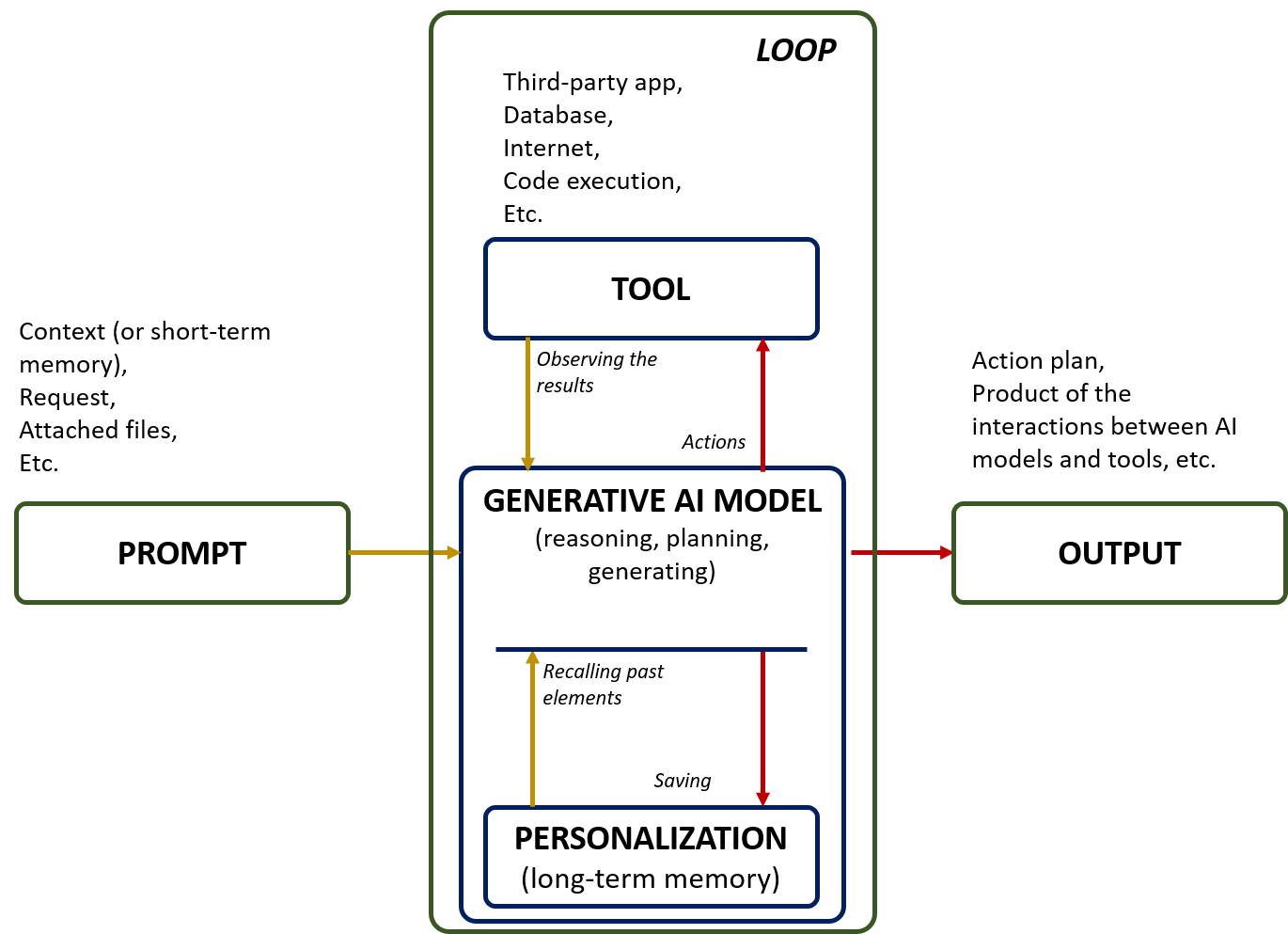
Components and operating principles of an AI agent. Starting from a user's request, the AI agent uses its reasoning and planning capabilities to decide whether and how to interact with the tools to which it is connected. This iterative process enables the conversational agent to act upon its environment (i.e., the available tools) while continuously observing the outcomes of its actions. It can also rely on its personalisation features to tailor these actions to the individual user. Throughout this process, the operations performed are communicated back to the user through natural-language responses generated by the conversational agent. Some actions may require intermediate user approval or additional information before they can be completed.
The language model: the orchestractor
Several terms are used to refer to these models, including large language models (LLMs) and foundation models. In practice, these labels refer to the same class of generative AI systems, which are built upon:
- A probabilistic AI model trained on vast amounts of data. It can then generate natural-language responses to user queries based on the statistical distribution of the vocabulary it has learned.
- Reasoning capabilities that enable the model to break down a user's request into a sequence of steps required to accomplish the task. In some cases, a human may intervene to validate the proposed decomposition.
- Personalization features, including custom instructions and a form of memory that allows the model to reuse information. This information may be explicitly provided by the user, retrieved from previous conversations, or automatically inferred and stored by the model.
ChatGPT (OpenAI) has progressively incorporated these capabilities over time. The first version of ChatGPT, based on GPT-3.5 and released in November 2022, consisted solely of a generative language model. In 2023, GPT-4 introduced advanced reasoning capabilities along with custom instructions, followed by memory features from February 2024 onward. A similar evolution can be observed in other AI model providers, such as Le Chat (Mistral), which has progressively added comparable capabilities since its launch in February 2024.
Tools connected to the language model
The language model can then invoke external tools to retrieve information, as described above, by accessing:
- The Internet, enabling it to obtain up-to-date information;
- External knowledge bases through Retrieval-Augmented Generation (RAG);
- Cloud-hosted services;
- And many other external resources.
This autonomous access to data allows the language model to retrieve the information it needs without requiring the user to provide it manually in their prompt.
Connecting language models to external tools also enables them to take actions within their environment, which may include:
- Other AI models, such as image and video generation models, when users request those capabilities;
- Development environments, where the AI model can generate code and build software projects based on user requests;
- Third-party applications, on which the model can perform actions such as sending emails, creating playlists on music streaming platforms, scheduling appointments based on available time slots, and more.
Interactions with these third-party applications rely on standard communication protocols, which provide a common interface between language models and external services. Thanks to their generative capabilities, language models formulate requests to the applications' APIs (Application Programming Interfaces), triggering function calls based on documentation that has been included in the model's context. This capability, known as function calling, refers to a language model's ability to invoke functions exposed by a software application in order to perform specific actions. Today, the Model Context Protocol (MCP), developed by Anthropic, has emerged as the dominant standard across most agentic AI use cases.
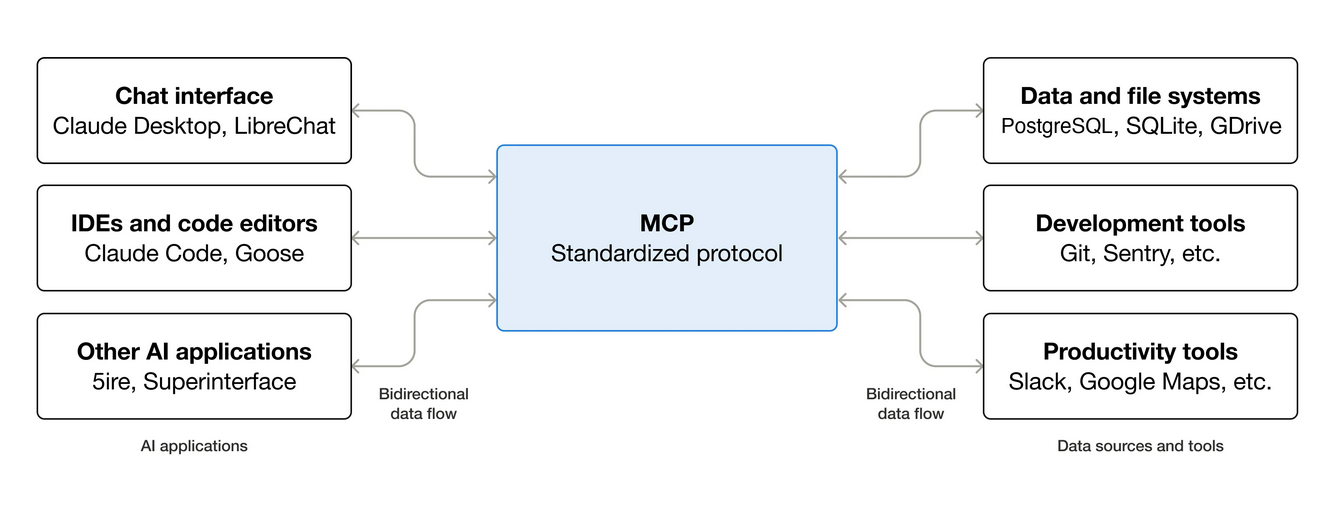
Illustration of the MCP Protocol available on the documentation website. It enables standardized interactions between a generative AI model and its connected tools.
Other protocols also exist, such as the Agentic Commerce Protocol (ACP) proposed by OpenAI, which is specifically designed for agentic commerce. In France, the DINUM (Interministerial Digital Directorate) is, for example, experimenting with the deployment of an MCP server for the data.gouv.fr platform.
ChatGPT first introduced web browsing capabilities in March 2023. Image generation models were subsequently integrated into the ChatGPT interface in October 2023. It was not until June 2025 that support for the Model Context Protocol (MCP) was introduced, enabling ChatGPT to interact with a much broader range of third-party applications. The Agentic Commerce Protocol (ACP), meanwhile, was introduced in September 2025. Similarly, Le Chat incorporated web search and image generation capabilities in November 2024, followed by support for connecting to third-party applications in May 2026.
Interaction between AI Agents
Finally, AI agents that can interact with users in natural language, reason about requests, devise a plan of action, and execute it through the external tools to which they are connected can also communicate with one another. In such systems, each agent is assigned a specific role that it is expected to fulfill.
The degree of autonomy and human involvement in these interactions can vary considerably. A user may manually invoke each agent they have created to perform the tasks for which it specializes and then pass the relevant information on to other agents. However, it is equally possible to envision agents coordinating their activities entirely autonomously.
The range of applications for these AI agents is broad and spans different levels of autonomy, including:
- Software development, with agents capable of interacting autonomously with development environments to generate code, execute functions, and perform related tasks;
- Online shopping assistants, supporting users from product selection through to final purchase confirmation;
- Autonomous financial agents;
- Email workflow management agents;
- And many other applications.
The first versions of custom AI agents appeared in ChatGPT in November 2023. Initially, these were limited to custom instructions that could be assigned to each agent to perform specific tasks in particular contexts. The Codex App desktop application, announced in February 2026, is expected to enable the orchestration of multiple agents specialized in software development. Comparable capabilities have been available since February 2024 on Mistral's La Plateforme, which allows users to create specialized AI agents.
These multi-agent systems - now commonly referred to as agentic AI systems and orchestrated by large language models - have become particularly popular in recent months. As we have seen, however, the terms AI agent, multi-agent system, and, by extension, agentic AI can refer to a much broader and longer-established family of systems than those based on generative AI models. It is therefore important to examine the meaning we assign to these terms in order to better define their scope and assess the challenges raised by the deployment of such systems today.
Agentic AI and AI Agents: a definitional challenge for regulation
Having outlined the building blocks of modern AI agents, we can now return to the question of how to define these systems rigorously and determine their scope. As the previous section has shown, an AI agent can be understood as the result of a series of innovations built upon generative AI models. This makes it essential to clarify what is actually meant by this term.
A growing number of regulatory authorities have addressed this issue, each proposing its own definition of agentic AI and AI agents. In the following sections, we review the various definitions put forward by French and European institutions, highlighting both their common ground and their differences in order to examine more closely the meaning and scope of these terms.
What do we mean by Agentic AI and AI Agents today?
Recent definitions are close to those of multi-agent systems…
At first glance, the definitions proposed by the various institutions appear broad and highly inclusive. In its FAQ, the European Commission describes AI agents as AI systems that “must be capable of receiving and processing information from their environment and, based on this processing, carrying out actions that may interact with or influence their environment (for example, by making function calls).” Similarly, in its report on agentic AI, the ICO defines AI agents as follows: “an agent is a software or system that can carry out processes or tasks with varying levels of sophistication and autonomy.” These definitions are sufficiently broad and inclusive to encompass all the agents described in the previous sections, whether or not they rely on generative AI models.
The same applies to the AEPD’s definition of an agentic AI system, which it summarizes as “one or more agents implementing different reasoning patterns.” The AEPD is joined by the European Commission, which explains that “the term ‘agentic AI’ is sometimes used to refer to more sophisticated configurations that integrate multiple AI agents.” At first sight, it therefore appears that defining agentic AI simply amounts to considering a multi-agent system, without further qualification. The EDPS also adopts very broad definitions: “while AI agents are single systems that can autonomously perform certain tasks […], agentic AI goes further by coordinating multiple agents.”
The CIANum, for its part, proposes a single, broader definition that does not distinguish between AI agents and agentic AI: “An AI agent is a computer program capable of making decisions or carrying out actions, including coordinating them with one another, by relying on artificial intelligence models,” and recommends favoring the term agentic AI.
It is worth noting, however, that these definitions all incorporate the key concepts associated with AI agents: autonomy, the ability to reason in order to achieve a goal, and the ability to interact with their environment. Meanwhile, agentic AI appears to refer more specifically to systems involving the coordination of multiple such agents.
… which nevertheless remain entered around generative AI models
However, language models are ubiquitous in the current landscape of definitions, sometimes implicitly. Indeed, the EDPS does not explicitly mention language models in its definitions, but the examples it provides exclusively involve AI agents and agentic AI systems based on foundation models, referring to the MCP and ACP protocols introduced in the previous section. Some authorities, however, are more explicit. In its report, the AEPD states: “An AI agent is an AI system that uses language models to achieve objectives.” Among the components that make up an agentic AI system, it also identifies “one or more language models (locally or in the cloud).” Similarly, while the ICO defines AI agents within a broad scope, its definition of agentic AI becomes more precise and removes any ambiguity regarding the systems concerned: “When LLMs or foundation models are integrated with other tools, […], they create what the industry calls ‘agentic AI’.” The ICO also uses the term agentic LLM, which further clarifies the types of systems covered by this definition. In conclusion, an article published by Inria confirms this perspective: “Agentic AI systems today rely heavily on generative models (particularly LLMs).”
To support this commonly accepted interpretation, we can refer back to the article by Sapkota et al. (2025), which defines agentic AI as “a recent paradigm based on deep learning, reinforcement learning, and foundation models, designed to provide AI agents with the ability to analyze their operational context, learn continuously, and exhibit emerging levels of autonomy.”
Even when not explicitly stated, it is clear that language models are at the core of what is now referred to as an AI agent or an agentic AI system. Furthermore, institutions generally appear to agree that agentic AI consists of a multi-agent system in which agents are orchestrated by foundation models and exhibit varying levels of autonomy. One final question nevertheless remains when considering the chronological evolution of the innovations that have led to modern agentic AI: at what level of autonomy should a language model be considered an AI agent?
Generative AI or Agentic AI: where are the boundaries?
As Inria explains in a dedicated article, autonomy is the key concept for characterizing an AI agent, particularly in its ability to act upon its environment: “It is this notion of autonomy in action (rather than merely access to information) that characterizes agentic AI.” This principle echoes the etymology of the term itself (derived from the Latin word meaning “to act”), as recalled in the introduction of this article.
The CIANum, for example, proposes classifying agentic AI systems into five levels of autonomy, ranging from the simple reproduction of predefined rules (which is more closely associated with pre-LLM-era AI agents) to fully autonomous workflows in which no human intervention is involved in intermediate decision-making processes required to complete the requested task. This final level remains, at present, a future horizon for agentic AI based on foundation models and also raises fundamental legal questions, particularly regarding human involvement in decision-making processes.
This initial proposal for classifying agentic AI systems according to their level of autonomy is valuable, but it remains broad and applies to multi-agent systems as a whole, without distinguishing between agentic AI systems that incorporate generative AI and those that do not. As a complement, it may therefore be useful to define autonomy levels specifically for agentic AI systems based on generative AI models, as proposed by Hugging Face. The first level of agentic AI would be reached when the output generated by an AI agent is capable of directing an action workflow, while the highest level would involve not only the ability to use tools and perform multi-step reasoning, but also to coordinate workflows involving multiple AI agents.
Nevertheless, agentic properties appear to stem from an AI agent’s ability to take action and modify the state of its environment (external systems, third-party applications, and so on).
Focus: the term conversational agent
Finally, it is important to examine the term conversational agent. It refers to generative AI systems that enable users to interact with them through natural language. The use of the term “agent” would therefore imply that the system in question has a sufficient level of autonomy to fall within this scope of definition.
In practice, however, in common usage, the term conversational agent refers to AI systems based on generative AI models that enable natural-language interactions. These range from the simplest chatbots (a term that also helps distinguish them from agentic AI systems) to systems connected to third-party tools that can operate with varying levels of autonomy.
This terminological issue raises questions about the actual relationship between the way a product is labeled, the underlying technology, its functionalities, and changing trends. For example, Siri and Alexa were once described as “voice assistants.” Today, the term conversational agent increasingly tends to be used to refer to similar tools. While the underlying technologies have evolved, the functionalities offered remain, to some extent, comparable, enabling users to interact with their devices through voice commands.
Conclusion: continuous integration into regulation?
The transition from generative AI to agentic AI represents a change in scale that renews and amplifies the risks to users’ personal data. Capable of accessing and processing large volumes of data from the multiple sources to which they are connected, while also taking actions within their environment, agentic AI systems involve the circulation of personal data across numerous services. In addition, the retention of interaction histories with users and the use of persistent memory mechanisms further increase the amount of data stored by these systems across various platforms. These mechanisms therefore facilitate the creation of highly personalized user profiles and greater autonomous decision-making capabilities.
In a joint note with the CIANum, the CNIL examines the challenges posed by agentic AI for personal data protection. Indeed, the data flows generated by agentic AI systems can be difficult for users to understand, creating a genuine risk of losing control over their personal data and questioning the ability of those systems to comply with the principles established by the General Data Protection Regulation (GDPR).
Agentic AI systems also raise questions regarding the allocation of responsibilities among stakeholders, due to the delegation of authority they enable. Their ability to act autonomously and interact with third-party applications allows them to automate decision-making processes involving multiple actors. Those decentralized operations make it more complex to identify the responsibilities of each party and extend cybersecurity risks to all services connected to agentic AI systems.
Given the risks associated with the development and deployment of agentic AI systems, the applicable legal framework appears to be an essential tool for managing these emerging uses. While the main instruments of European data protection law and artificial intelligence regulation already apply to these systems, their specific characteristics - autonomous decision-making, persistent memory, the ability to interact with multiple services, and the capacity to act on behalf of users - call for adaptations in how these rules are implemented.
Illustration : pexels