Rage against the Flock: the surveillance company at the heart of controversies in the United States
Rédigé par Régis Chatellier
-
23 September 2026From a student project to a network of 120,000 cameras across the United States, the intrusive nature of the surveillance system developed by Flock Safety has sparked widespread protests among the public in the US.
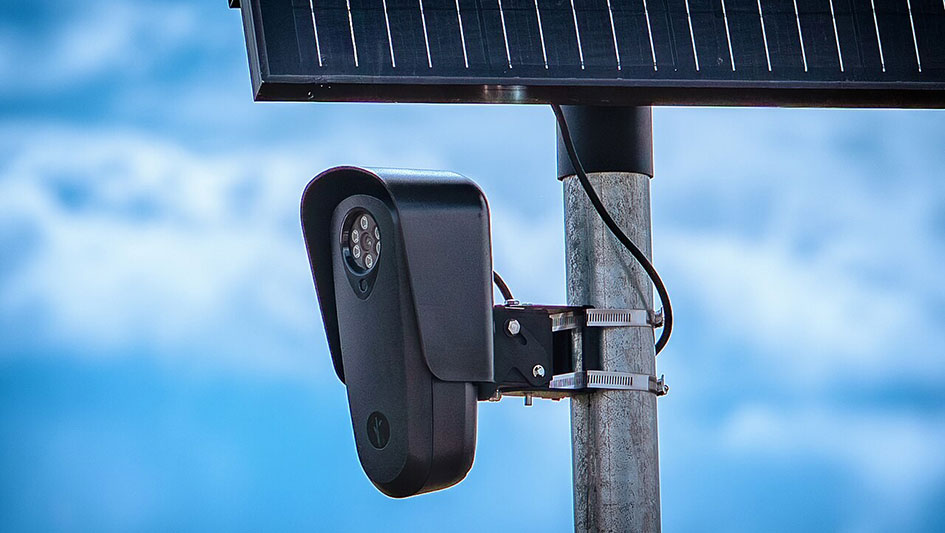
Adopted on a massive scale by local law enforcement agencies across the United States, Flock cameras, which use automatic license plate recognition (ALPR) technology and are named after the company that supplies them, have sparked protests among the public, well beyond digital rights advocacy groups.
These augmented cameras, which use artificial intelligence to identify and track vehicles, are being deployed on a large scale across the country. Their success can be attributed in part to the low cost of the devices, but also, and above all, to their interconnectivity, creating a nationwide distributed surveillance system.
In 2026, cases of misuse and abuse have multiplied, prompting action among the public and even among the company’s customers, some of whom have terminated their contractual relationships with the company. Such movements are quite unprecedented in the United States.
From a student project to a market-leading company
Founded in 2017 in Atlanta by three Georgia Tech students, Garrett Langley, Paige Todd, and Matt Feury, Flock’s trajectory follows the tradition of many Silicon Valley startups. In a New York Times podcast, journalist Kashmir Hill speaks with Garrett Langley, now the company’s CEO, who recounts the company’s history. After cars were being broken into every weekend near his home, he called the local police to file a report and was told that there was nothing they could do unless they were provided with the license plate numbers of the burglars. As an engineer who “knew nothing about law enforcement or public safety,” he then decided to call his two classmates to “install license plate recognition cameras in the neighborhoods.” The first version consisted of a phone powered by a solar panel, installed on a lamppost, which took pictures of passing cars. Gradually, the three co-founders began selling their system to other residential communities, and then, starting in 2020, to local police departments. That was when the company really began to grow. The cameras were no longer installed solely on private property, but also in public spaces.
Although the company is not the only one in the U.S. license plate reader camera market, companies such as Axon, Motorola Solutions, and Verkada have been offering similar solutions for many years, Flock has quickly established itself as a major player. As of 2026, it has 120,000 of these cameras deployed across the country, in every state except Alaska. Some 7,000 police departments have signed contracts with Flock Safety, representing roughly 40% of all police departments nationwide. The company is valued at more than $8 billion.
A success that is reminiscent of that of the startup Ring, acquired by Amazon in 2018, which built a video surveillance network in the United States using connected doorbells purchased by private individuals, giving remote access to footage when someone rings the bell or when motion is detected. This footage is pooled into a video surveillance system accessible to Ring’s partner police departments. Some municipalities even offered to subsidize the purchase of Ring cameras by their residents, viewing them as an investment in public safety that was less costly than deploying a system of their own. Ring also experienced setbacks, notably when it had to disable the RFA, or “request for assistance” feature of its Neighbors app in January 2024, which allowed police departments to issue requests for videos and information as part of investigations. Patterns of racial bias and prejudice, as well as data protection risks, had been observed and denounced as early as 2021. While a similar tool, “Community Requests” was relaunched in September 2025 as part of a partnership with Axon, the agreement reached with Flock in October 2025 ended in February 2026. Following the controversy sparked by an advertisement aired during halftime of the Super Bowl, which raised concerns about the development of facial recognition technology, Ring abandoned its partnership with Flock, which notably provided for the integration of Flock’s automated license plate recognition technology into Community Requests.
How do these cameras work?
Flock’s augmented cameras are not simply automated license plate reader (ALPR) systems. They can also identify a vehicle’s color, brand, and model, as well as the presence of a bumper sticker, visible damage to the bodywork, or an item visible inside the vehicle. The images therefore provide much richer information than a simple “ID card” number for the vehicle. The information collected is retained for thirty days, during which time the police can run searches to locate a vehicle, activate alert systems if it passes in front of a camera, and so on.
The data accessible to police departments is not limited to data collected within their own jurisdiction as part of their contractual relationship with Flock, but also includes data collected nationwide. If an alert is issued in a city or region, the search for the vehicle will be conducted across the entire area of the United States covered by Flock cameras.
This private network for monitoring public spaces initially expanded without Flock seeking permits to install its cameras, as Kashmir Hill explains: “When they first began working with the police, they still had that typical Silicon Valley ‘Move Fast, Break Things’ approach, which led them to install these cameras more or less wherever they wanted,” in unusual locations where people were not accustomed to being monitored, on rural roads, or in areas where there were otherwise no cameras. “This got them into trouble with transportation departments, which require a permit to be obtained”. The locations of the cameras are now chosen jointly by Flock and its customers and are subject to a business license to operate.
The poorly regulated development of surveillance technologies is nothing new. The startup Clearview AI, for instance, trained its algorithms on databases of photographs it had collected from major social networks (LinkedIn, Facebook), as well as from the press, to develop a facial recognition system that it subsequently sold to law enforcement agencies in several countries, particularly in the United States. In 2022, following a complaint by Privacy International, France’s data protection authority (CNIL) imposed a €20 million fine on the company and ordered it to stop collecting and using, without a legal basis, the data of people in France and to delete the data it had already collected.
A centralized, interconnected system controlled by its clients
The cameras developed by Flock Safety do not stand out for their use of revolutionary technologies. They are simply solar-powered cameras mounted on poles, and the algorithms they use are fairly widespread. Rather, the value of the system lies in the very broad deployment of these devices and their interconnection, creating a surveillance network that had never previously been available on such a scale in the United States. This is why so many local police departments have entered into contracts with the Atlanta-based company.
Where previously investigations extending beyond the boundaries of a state or county required police departments to establish partnerships across jurisdictions, they now only need to log into an online search engine, enter a license plate number or vehicle characteristics to conduct a search, or set up an alert in case the vehicle passes within the field of view of a camera. The search is conducted across the entire network, provided that the police department has configured its settings to allow nationwide access to the cameras in its own local network. It remains possible to restrict a surveillance system locally, but doing so means that the data can no longer be accessed nationwide. In practice, Kashmir Hill reports comments by Garret Langley, who acknowledges that “the vast majority of its customers opt for the national network”.
Enabling abuse and misuse
Control over access to the system, as well as oversight of how the database is used and the purposes for which searches are conducted, remains at the discretion of Flock’s customers. They are expected to commit to complying with the legal framework, but are not subject to any meaningful enforcement mechanism. Several examples of abusive uses have been reported by media outlets and NGOs.
As early as May 2025, the investigative website 404 Media (which has extensively documented the issue) reported the case of a Texas police officer who had accessed camera data at the national level to track down a woman who had undergone an abortion, including in states where abortion is legal, such as Illinois and Washington State. Flock’s CEO has since attempted to dispute this alleged misuse, despite the fact that it was documented in an investigation by the Electronic Frontier Foundation, which had gained access to court records.
According to The Washington Post, at least 50 police officers in the United States have recently been charged with or accused of misusing license plate readers. Forty-six of these cases involved Flock’s software. In more than half of the cases, the alleged target was a wife, girlfriend, ex-partner, an ex-partner’s new boyfriend, or a woman the officer wanted to meet. The CNN website reported in August 2026, for example, on the case of a Kentucky police officer who was arrested after it was established that he had conducted more than 200 searches in the Flock Safety database to track his ex-girlfriend. At the same time, he had harassed her and made threatening remarks, leading her to request protection.
Immigration and Customs Enforcement (ICE) officers theoretically do not have access to Flock data. In a blog post published in January 2026, Flock states that “ICE is not a partner, and sharing with federal agencies is disabled by default”. The article nevertheless specifies that “if a local authority chooses not to collaborate with any federal entity, including ICE, Flock does not have the power to override that decision. Likewise, if a community chooses to collaborate with a federal agency, Flock does not have the power to alter that decision”. The company therefore acknowledges that its systems can be used by immigration enforcement authorities whenever one of its customers grants them access or extracts information on their behalf.
Flock also claims to have implemented several oversight mechanisms and safeguards, including measures designed to allow abortion-related searches only in states where abortion is illegal, as well as measures to alert police departments when officers conduct unusual searches or searches unrelated to an official investigation.
Wired magazine was able to test Flock’s latest software update, including its FreeForm feature, which allows full-text searches of the database. Police officers no longer enter only a license plate number; they can also write a description of the vehicle or person they are looking for. An AI-powered system analyses the searches and generates warnings. The system first warns police officers that the results may be inaccurate or incomplete and should not be considered the sole reliable source of information. It also evaluates an officer’s written description against several categories of sensitive content, including race and religion, which are prohibited, as well as “political, social, and cultural expression,” the latter of which does not prevent a search from being conducted. Yet, as Tom Bowman of the Center for Democracy and Technology points out in Wired, political and cultural expression is “one of the most protected areas” under the First Amendment to the U.S. Constitution. Yet it “seems to be the one that raises the least concern from a law enforcement perspective,” as well as from Flock’s.
The real control, however, lies with each of the company’s individual customers. Flock maintains that much of the responsibility for managing its technology falls to local authorities, which set their own rules governing access and use. The company states in its blog post that “all data collected by Flock license plate readers is owned and controlled by the customer, whether that customer is a city, county, school district, or private organization. Customer ownership of data is central to how Flock operates”.
It is worth pointing out, however, that making powerful features available to users, when the legal conditions governing their use are not built into the system as genuine safeguards, quite naturally leads to misuse.
Unprecedented wave of protests in the United States
Following the various cases brought to light by the press, Flock is facing a wave of protests across the United States, involving more than just digital rights activists. Kashmir Hill notes on the New York Times podcast: “What struck me about the reactions to Flock cameras is precisely how bipartisan they are. Both the left and the right have reservations about these cameras. There’s a kind of broad consensus. And that’s what really stood out to me”.
On August 28, 2026, Newsweek published a map identifying 149 cities across the country that had taken action against Flock cameras, including banning the cameras, cancelling or rejecting contracts, or deactivating cameras.
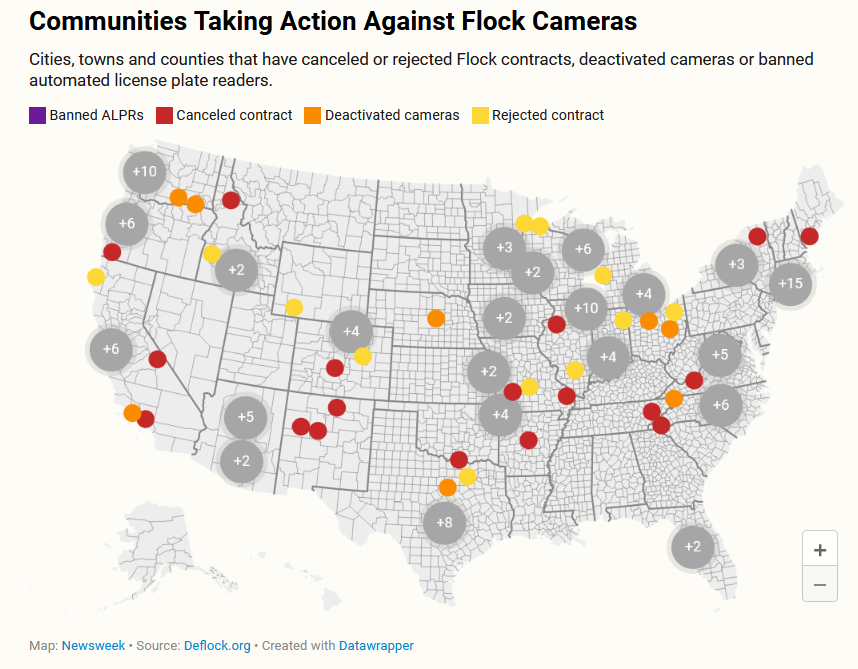
Map published by Newsweek showing 149 U.S. cities that have taken action against Flock cameras
Some cities that were Flock customers, surprised to learn that their cameras had been used for immigration enforcement, suspended or terminated their contracts because they had not realized that by making this data available nationwide, they were indirectly making it accessible to federal agencies such as ICE.
Organizations had previously filed lawsuits, notably on the grounds of the Fourth Amendment to the U.S. Constitution, which protects U.S. citizens from unreasonable searches and seizures and requires a warrant for any search.
This type of action and protest in the name of privacy protection remains relatively unprecedented in the United States, and Kashmir Hill attributes it to several factors. As she explains, “the physical aspect plays a role here.” Whereas “many of our privacy concerns involve invisible tracking and online data collection, with Flock cameras, you can actually see what is happening, how it is happening, and where it is happening”. Another important factor is the location where the data is collected, and the fact that “people are very attached to the privacy associated with their cars,” in a context where “Americans see their cars as a kind of symbol of freedom, a way to get away from everyone”. She has observed that “these cameras really make people angry, and that they have sparked an uproar over privacy unlike anything I’ve ever seen before”. According to NPR, Flock cameras have been vandalized in at least 36 states. They have been stolen, sawed down, struck, covered with paint and stickers, and even targeted by gunfire.
Towards a game of hide-and-seek?
The visibility of these ALPR cameras in public spaces appears to be the problem that their proponents need to address in order to prevent the public from paying attention to them. In an article published on August 3, 2026, 404 Media reported comments made during a webinar hosted by Axon, a competitor to Flock, in which the company discussed requests it had received to produce cameras with a different physical design from Flock’s cameras, so that they would not be recognized as ALPR cameras and would not be vandalized.
As early as 2019, the French data protection authority (CNIL) warned of the risks associated with making surveillance invisible, in the context of facial recognition, but its concerns apply more broadly to “contactless” technologies whenever “certain systems [cause] the machine to disappear entirely from the user’s field of vision”. It noted that “some friction is useful,” as it provides “points of contact for individuals, reminders of the reality and consequences of their interactions with digital tools, and may also provide an opportunity for people to exercise their rights”.
What about France?
Flock Safety does not distribute its system in France, where the use of ALPR cameras, as well as so-called “augmented” cameras, is regulated.
The use of ALPR-type systems is authorized for the enforcement of the post-parking fee (which replaces the fine for unpaid parking). However, under the current regulatory framework, the collection and processing of photographs of vehicles, particularly close-up images of license plates, for the purpose of exercising judicial police powers by municipalities (in connection with offenses provided for under the French Highway Code) is not authorized. The decree of April 14, 2009, which allows municipalities to implement automated processing systems for the detection and prosecution of criminal offenses, does not provide for the collection of photographic files. The use of ALPR systems, which systematically collect a photograph of the vehicle, is therefore not possible for municipalities seeking to detect offenses unless this decree is amended.
Furthermore, Article L233-1 of the French Internal Security Code limits the use of “fixed or mobile automated systems for checking vehicle identification data that photograph the occupants of the vehicles” by the national police, national gendarmerie, and customs authorities to a limited number of offenses, as listed in the article.
Regarding so-called “augmented” cameras combined with automated image-analysis software, which can film people and also analyse them automatically in real time in order to infer certain information about them (such as counting the number of people in a given area, detecting an abandoned bag, identifying whether someone is wearing a mask, etc.), the automatic search function is authorized only in response to judicial requests. Its use is lawful provided that it is necessary to properly respond to the request and that the system is sufficiently secure. In particular, it may be used to search for a vehicle’s license plate number. The CNIL points out that municipal police officers cannot themselves conduct judicial police investigations and are therefore not authorized to carry out such searches on their own initiative, outside the scope of a judicial request.
Illustration : Tony Webster - Flock Safety License Plate Reader Camera in Colorado - CC-BY-40